
Decoding the Customer Persona Periodic Table
Your Blueprint for Data-Driven Marketing Success
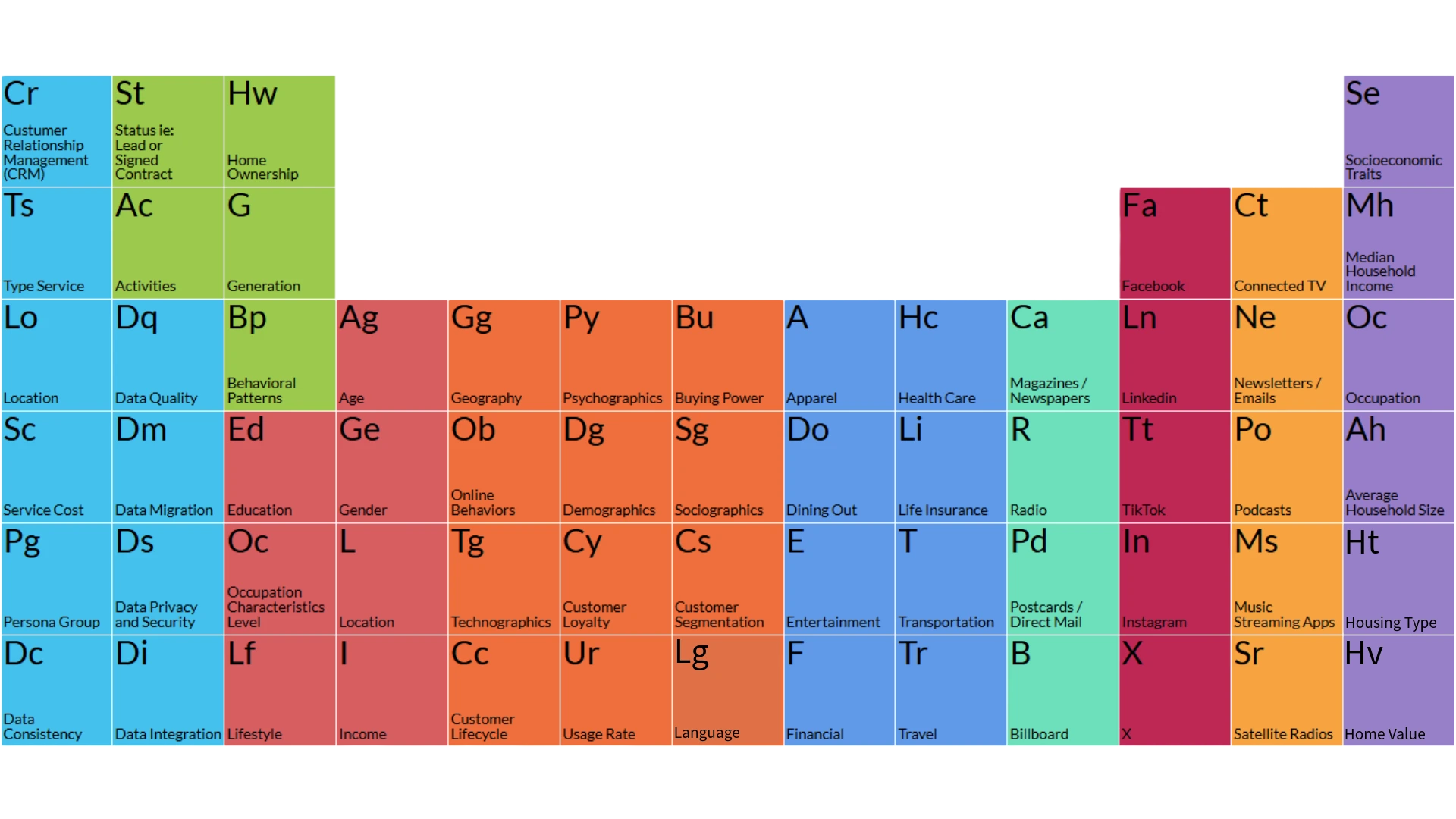
Our Customer Persona Periodic Table organizes 118 key marketing elements into color-coded categories, turning complex audience data into clear, actionable insights.
Just as the scientific periodic table revolutionized chemistry by revealing relationships among elements, this framework brings structure to customer research. It highlights meaningful connections, simplifies segmentation, and uncovers new opportunities for growth.
Each color represents a distinct area of customer intelligence — from basic demographics to advanced behavioral insights. This systematic approach empowers your business to build accurate buyer personas that inform every marketing decision.
Instead of collecting scattered data points, the Persona Periodic Table transforms guesswork into strategic precision.
Why Persona Blueprints?
Unlike agencies that rely on outdated demographic assumptions, Persona Blueprints applies a scientific framework across 118 data points to create complete, evidence-based customer profiles.
Our method eliminates guesswork, improves ROI, and helps service-based businesses make smarter, data-backed marketing decisions.
Persona Blueprint Periodic Table To Success
Data Management and Infrastructure Foundation

Strong data management is the backbone of any data-driven marketing strategy. These foundational elements ensure your customer intelligence is accurate, consistent, and accessible — the key to reliable insights and successful campaigns.
Without a solid infrastructure, even the most detailed psychographic data can lead to poor decisions. Our systems maintain real-time accuracy and integrity across every marketing platform.
- Cr (Customer Relationship Management): Centralized systems that track customer interactions, communication history, and relationships, enabling personalized marketing and better conversion rates.
- Ts (Type Service): Categorizes services to match customer needs and expectations, improving positioning and satisfaction.
- Lo (Location): Enables precise geographic targeting for regional or local market optimization — essential for location-based industries like roofing or home services.
- Sc (Service Cost): Analyzes pricing to align offers with customer budgets while maintaining profit margins.
- Pg (Persona Group): Segments audiences into actionable categories for more effective campaign targeting.
- Dc (Data Consistency): Maintains uniform insights across platforms, ensuring reliable strategic decisions.
- Dq (Data Quality): Validates data accuracy so campaigns reach the right audience with relevant messaging.
- Dm (Data Migration): Ensures seamless data transfers between systems without losing historical context.
- Ds (Data Privacy & Security): Protects sensitive information and ensures compliance with privacy regulations.
- Di (Data Integration): Combines data from multiple sources to create complete, unified customer profiles.
Customer Activities and Behavioral Intelligence

Understanding how customers behave helps your business design strategies that align with real decision-making patterns. Behavioral insights reveal not just who your customers are, but how and why they buy.
- St (Status): Tracks leads from prospect to contract, supporting targeted communication at each stage.
- Ac (Activities): Analyzes engagement patterns to optimize timing, channel use, and content relevance.
- Hw (Home Ownership): Identifies property owners who are most likely to need long-term services.
- G (Generation): Reveals age-based communication and platform preferences for precise messaging.
- Bp (Behavioral Patterns): Predicts future needs through recurring behavior trends, enabling proactive campaigns.
Behavioral Intelligence That Converts
Our proprietary system identifies homeowners 6–18 months before they need roofing services.
While competitors chase emergencies, you’ll capture high-margin, planned replacements with longer, more profitable sales cycles.
Core Demographics and Psychographic Profiles

Demographic and psychographic insights form the foundation of audience targeting. They help tailor your message to customer values, preferences, and decision-making styles.
- Ed (Education): Guides content complexity and tone.
- Oc (Occupation Characteristics): Reveals purchasing authority and professional context.
- Lf (Lifestyle): Connects services to customer interests and values.
- Ag (Age): Aligns communication style with generational priorities.
- Ge (Gender): Identifies messaging styles that resonate with gender-based preferences.
- L (Location): Enables hyperlocal targeting and neighborhood-level optimization.
- I (Income): Aligns pricing and messaging with financial capacity.
Advanced Demographics and Market Intelligence

These advanced elements combine traditional customer data with deeper behavioral and market intelligence.
- Gg (Geography): Adapts campaigns to regional and climate-based needs.
- Ob (Online Behaviors): Tracks digital engagement for optimized UX and targeting.
- Tg (Technographics): Measures technology adoption for the right digital approach.
- Cc (Customer Lifecycle): Identifies customer journey stages for timely outreach.
- Py (Psychographics): Maps personality traits, values, and motivations that drive brand loyalty.
- Dg (Demographics): Guides audience targeting, campaign development, and market analysis.
- Cy (Customer Loyalty): Reveals what keeps customers coming back.
- Ur (Usage Rate): Enables usage-based segmentation.
- Bu (Buying Power): Ensures focus on qualified, high-value prospects.
- Sg (Sociographics): Examines social influence patterns to leverage community and peer networks.
- Cs (Customer Segmentation): Organizes customers into actionable groups.
- Lg (Language): Supports inclusive marketing and community trust.
Continual Campaign Optimization
Our team continually monitors and refines campaigns across U.S. and Canadian markets — ensuring maximum performance every day.
Service Categories and Lifestyle Preferences

By analyzing how customers engage across service industries, you can better position your offerings and identify emerging opportunities.
- A (Apparel): Indicates style preferences and spending behavior.
- Do (Dining Out): Reflects lifestyle priorities and social habits.
- E (Entertainment): Guides engagement and content strategy.
- F (Financial): Reveals financial planning sophistication.
- Hc (Health Care): Highlights attitudes toward wellness and professional expertise.
- Li (Life Insurance): Signals long-term planning and financial responsibility.
- T (Transportation): Shows convenience and environmental priorities.
- Tr (Travel): Reflects disposable income and lifestyle sophistication.
Traditional Media and Direct Marketing

Traditional media remains a vital part of local marketing strategies, reinforcing digital efforts and maintaining brand visibility.
- Ca (Magazines/Newspapers): Targets audiences through trusted editorial environments.
- R (Radio): Leverages commute-time engagement.
- Pd (Direct Mail): Delivers tangible marketing materials to decision-makers at home.
- B (Billboard): Strengthens local awareness and brand recognition.
Social Media and Digital Platform Engagement

Each social platform has its own audience and engagement style. Persona Blueprints tailors content strategies to maximize performance across all major networks.
- Fa (Facebook): Builds community trust and referrals.
- Ln (LinkedIn): Positions brands as industry leaders.
- Tt (TikTok): Reaches younger audiences with authentic storytelling.
- In (Instagram): Showcases visual work and builds brand aesthetics.
- X (Twitter/X): Facilitates real-time engagement and customer service.
Stop Wasting Your Marketing Budget
Most local businesses waste ad spend targeting the wrong audiences.
Persona Blueprints’ data-driven infrastructure pinpoints your ideal customers, ensuring every dollar reaches qualified prospects ready to buy.
Content Consumption and Media Preferences

Modern content consumption habits reveal where your audience spends time — from connected TV to podcasts.
- Ct (Connected TV): Enables precise ad placement through streaming services.
- Ne (Newsletters/Emails): Strengthens direct customer relationships.
- Po (Podcasts): Connects with audiences during multitasking or leisure time.
- Ms (Music Streaming): Offers focused, intent-based ad targeting.
- Sr (Satellite Radio): Reaches premium listeners with high engagement.
Economic and Housing Characteristics

Socioeconomic data adds valuable context to customer profiles, ensuring your marketing respects local community values and purchasing power.
- Se (Socioeconomic Traits): Captures lifestyle and spending trends.
- Mh (Median Household Income): Guides pricing and positioning strategies.
- Oc (Occupation): Defines purchasing authority and professional needs.
- Ah (Average Household Size): Informs service quantity and decision complexity.
- Ht (Housing Type): Detached or attached housing indicates the target customer.
- Hv (Home Value): Indicates the likely spending power for home services.
Your Success Is Our Success
At Persona Blueprints, we don’t just deliver data — we deliver results.
Our team becomes your strategic partner, turning insights into measurable revenue growth through data-driven marketing solutions.
Transform Your Marketing with Persona Blueprints
Stop competing on price. Start winning with data-driven precision. Persona Blueprints’ scientific approach helps service-based businesses improve lead quality, lower acquisition costs, and increase ROI.
Schedule your Persona Blueprints consultation today and see how data-driven marketing can revolutionize your strategy. Your ideal customers are out there — we’ll help you find them with accuracy and purpose.